Hood cleaning certification searches usually come from two different needs.
Some contractors want to understand training, credentials, license requirements, and what a customer may ask for before awarding work. Some customers ask for a “certification” when they really need a clear service record showing who cleaned the kitchen exhaust system, when it was cleaned, what was documented, and what still needs attention.
This guide separates those questions. HoodCleaningReport does not certify technicians, issue licenses, approve work, or replace NFPA 96. It helps kitchen exhaust cleaning contractors create customer-ready reports, certificates, PDFs, and customer records after the job.
For a completed job, build a factual hood cleaning service certificate first, then add photo, deficiency, access, and signoff evidence to a hood cleaning report template. For an explanation of the documents customers receive, read hood cleaning certificate vs service report.
Hood cleaning certification
Hood cleaning certification is a broad phrase. It can refer to training programs, company credentials, technician qualifications, state or local license rules, industry association programs, or customer contract requirements.
Before a contractor promises anything, separate these categories:
- Training a technician completed
- Certification a person or company actually holds
- State or local license required for the work
- Fire suppression credentials, if that work is in scope
- Customer vendor requirements
- Service documentation produced after each job
A report is not the same as a credential. A certificate of service is not the same as a certification program. Mixing those terms can create problems when a customer, insurer, property manager, or authority having jurisdiction asks for proof.
Kitchen hood cleaning certification vs service documentation
Customers often use “certification” as shorthand for proof. They may ask:
- “Can you send the hood cleaning certificate?”
- “Is the hood certified?”
- “Do you have proof for the fire marshal?”
- “Can you send the inspection report?”
- “Do you have the NFPA paperwork?”
Those questions do not all mean the same thing.
| Request | What it may mean | Safer contractor response |
|---|---|---|
| Hood cleaning certification | Technician credential, company qualification, or proof of service | Ask whether they need credentials, a certificate, or the full service report |
| Kitchen hood cleaning license | Local or state permission to perform certain work | Confirm the local requirement and show the relevant license when applicable |
| Hood cleaning certificate | Short proof that service happened | Send a factual service certificate and link to the detailed report |
| Hood cleaning report | Full job record | Include scope, photos, access notes, deficiencies, frequency, and signoff |
| NFPA 96 documentation | Records tied to kitchen exhaust cleaning expectations | Document the work while avoiding compliance guarantees |
The safest workflow is simple: keep technician and company credentials current, then create a clear report for every job.
Kitchen hood cleaning license questions
License rules can vary by state, city, fire district, customer type, and scope of work. Some places focus on fire suppression systems. Some customer contracts require specific training or proof of insurance. Some authorities may expect certain forms, tags, or submission steps.
Do not assume one national answer covers every job.
Before working in a new state or municipality, confirm:
- Whether kitchen exhaust cleaning requires a specific license or registration
- Whether fire suppression inspection, service, or repair is outside your cleaning scope
- Whether the authority having jurisdiction requires a particular credential
- Whether customer contracts require technician training records
- Whether reports must include license numbers, certification numbers, or service labels
- Whether records need to be submitted, retained, or available for inspection
HoodCleaningReport supports documentation fields and state-aware report details, but the contractor still needs to verify the local rules that apply to the work.
For what we found state by state, with the official source for each, read do you need a license to clean hoods.
Hood cleaning certification cost
Searches for hood cleaning certification cost usually signal a contractor comparing training options or a new entrant trying to understand the business.
Costs can depend on:
- The organization providing the training
- Whether training is online, in person, or hands-on
- Whether testing is included
- Whether renewal or recertification is required
- Travel, crew downtime, and study time
- Whether state or local license fees are separate
- Whether insurance, bond, or vendor enrollment costs apply
Treat certification cost as only one part of the operating cost. Customers and inspectors may also care about the record after each job. A credential helps show who is qualified. The report shows what happened at that location.
Typical published prices, checked in September 2026. Confirm the current fee with the provider before you enroll. Study guides, travel, renewal, and membership are often extra.
| Program | Typical published cost | What the listed price usually covers |
|---|---|---|
| IKECA CECS exam | $750 | Certified Exhaust Cleaning Specialist exam fee; submit the application first; study guide sold separately |
| IKECA CESI renewal | $185 | Certified Exhaust System Inspector renewal fee listed in the IKECA store; initial exam pricing is shown after sign-in |
| Third-party online hood cleaning courses | About $300 to $1,000 | Provider training or a certificate of completion; this is not an NFPA credential |
| Third-party in-person or bundled programs | About $1,000 to $2,500 | Multi-day or packaged training; tuition varies by school and whether fire-system classes are bundled |
IKECA fees change, and member pricing can differ from the public store listing. Third-party schools issue their own certificates. None of those prices buy an “NFPA 96 certification” from NFPA.
Hood cleaning certification online
Online hood cleaning certification searches often come from contractors looking for a faster path to training. Online programs can be useful for classroom material, terminology, safety topics, standards awareness, and refresher education.
But online training does not remove the need to verify:
- Whether the credential is accepted by the customer or AHJ
- Whether hands-on training is also required
- Whether the program covers the current standard and applicable local expectations
- Whether the credential belongs to the technician, the company, or both
- Whether renewal dates need to appear in internal records or customer reports
If a customer asks for proof, give them the actual credential information you hold. Do not turn a service certificate into a training credential.
NFPA 96 certification
NFPA 96 certification searches usually mean “what credential do I need for kitchen exhaust work?” NFPA writes and publishes NFPA 96. It does not certify hood cleaning technicians, companies, or completed jobs. Buying the standard, citing Table 11.4, or completing a third-party NFPA 96 awareness course does not make a person or a kitchen “NFPA certified.”
The bodies that actually issue credentials, licenses, or training certificates are separate from NFPA:
- IKECA, which offers individual credentials such as CECS, CECT, and CESI
- State or local licensing agencies, such as Massachusetts hood-cleaning licenses or FDNY Certificates of Fitness
- Customer, insurer, or property-manager vendor-approval programs
- Third-party training companies that issue their own certificates of completion
Confirm what the customer or authority having jurisdiction is asking for before naming a credential. A service certificate after a cleaning is still not a technician certification.
Contractors should also be careful with the phrase “NFPA 96 hood cleaning certification” because it can sound like NFPA itself certified a person, company, or job.
Use more precise language:
- “Technician training record”
- “Company credential”
- “Service certificate”
- “Cleaning report”
- “NFPA 96 documentation fields”
- “Report prepared to support customer and AHJ recordkeeping”
For documentation expectations around the standard, use the NFPA 96 hood cleaning requirements guide and the NFPA 96 hood cleaning checklist generator.
What a customer-facing service record should include
When a customer asks for proof after a hood cleaning job, the record should identify the service clearly.
Include:
- Contractor company name
- Customer and service location
- Service date
- Hood system or cookline serviced
- Technician or crew lead
- Areas cleaned
- Areas not accessed or not cleaned
- Before-and-after photos
- Deficiencies and recommended next steps
- Cleaning frequency and next service date
- Customer acknowledgement when available
- PDF or share link for retrieval later
A short certificate can summarize the job. The full report should carry the proof.
Credential language to avoid
Avoid wording that implies authority you do not have or a conclusion the document does not prove.
Do not write:
- “NFPA certified”
- “NFPA approved”
- “Certified compliant”
- “Fire marshal approved”
- “No further inspection required”
- “This certificate guarantees compliance”
- “This report replaces the standard”
Use factual language instead:
- “Service completed”
- “Technician credential listed”
- “Accessible areas cleaned”
- “Photos attached in the service report”
- “Deficiencies documented separately”
- “Confirm local requirements with the authority having jurisdiction”
The stronger document is the one that stays accurate under review.
How to connect credentials to reports
A contractor can keep credentials and service records in the same customer workflow without confusing them.
Recommended handoff:
- Keep license or certification numbers in the company and technician record
- Add required credential fields to the report when applicable
- Send the full hood cleaning report after each job
- Use the certificate as a cover record or summary, not the only proof
- Keep photos, deficiencies, access notes, and next service dates in the report
- Store the report where the customer can retrieve it later
That gives the customer what they usually wanted from the word “certification”: proof they can file, forward, and understand.
Final checklist
Before answering a certification or license request, confirm:
- What credential, license, or service document the customer is asking for
- Whether the request is local, contractual, or general proof-of-service language
- Whether your technician or company actually holds the credential being named
- Whether the report includes service date, scope, photos, access limits, deficiencies, and signoff
- Whether the certificate clearly points to the full report
- Whether the wording avoids compliance guarantees
HoodCleaningReport helps contractors turn job photos, field notes, credential fields, deficiencies, access limits, certificates, and customer signoff into branded PDFs and share links.
You can build a hood cleaning certificate, review a sample hood cleaning report PDF, compare hood cleaning report software, or create your first report when the next job needs a clean customer record.
Hood cleaning certification FAQ
Do you need a certification to clean commercial kitchen hoods?
Requirements depend on the state, city, authority having jurisdiction, work scope, and customer contract. Some jurisdictions require a specific license or certificate of competency. Others rely on qualification, training, or local registration rules. Verify the service address with the relevant authority before representing a technician as certified.
Do you need a hood cleaning license?
There is no single nationwide hood cleaning license that answers every job. A contractor may need business licensing, technician credentials, fire-department registration, or another jurisdiction-specific approval. The report should list only credentials the company or technician actually holds.
Is a service certificate the same as technician certification?
No. A service certificate records that work was performed at a location on a date. Technician certification or licensing describes a person’s or company’s qualification or authorization. Keep the credential field and the completed-service record distinct.
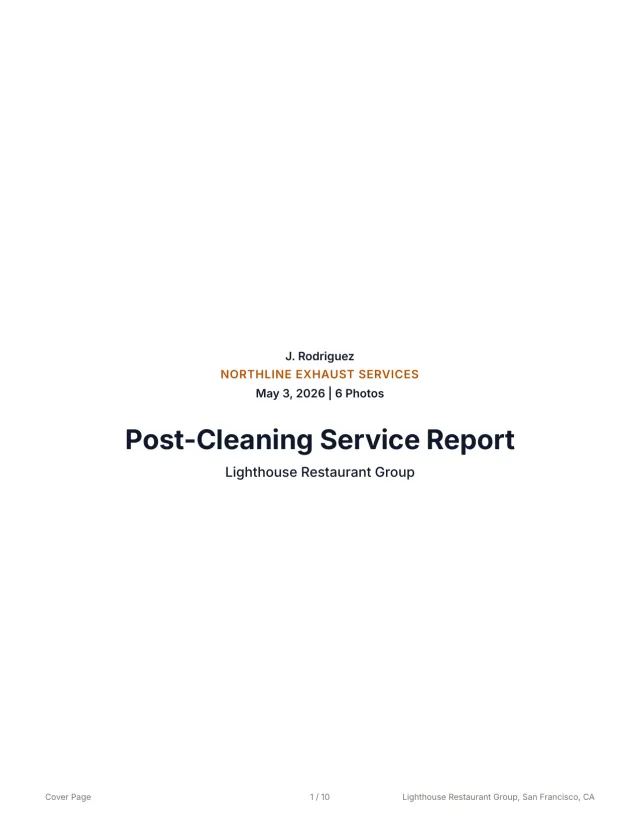 See a finished report The 10-page sample, the Certificate of Service, and the 3x5 sticker from one job.
 Related guides
Keep building the report record
Which states and cities require a license or certificate to clean kitchen exhaust systems, who issues it, and where the rules are written. Checked October 2026 against official sources.
Standards NFPA 96 Inspection Checklist for Kitchen Exhaust ContractorsUse this NFPA 96 inspection checklist to document kitchen exhaust scope, visible conditions, access, photos, deficiencies, frequency, and AHJ handoff.
Standards Commercial Kitchen Hood Cleaning Code Requirements ChecklistDocument commercial kitchen hood cleaning code requirements: scope, NFPA 96 records, access, deficiencies, photos, frequency, and AHJ handoff.
Send your next job as a finished report.
Your photos become a branded report, a Certificate of Service, and a 3x5 sticker, under one job number.
3 reports or 3 days free. No card.