A hood cleaning certificate is a short proof-of-service document. A hood cleaning service report is the full record of what your crew cleaned, photographed, found, could not access, and recommended next.
Customers often ask for a certificate because it sounds official and easy to file. Contractors should be careful with that request. A certificate can confirm that service happened, but it does not usually carry enough detail to answer follow-up questions from a fire marshal, insurer, property manager, or corporate facilities team.
Use the certificate when the customer needs a simple service record. Use the service report when the job needs customer-ready documentation. If the customer is asking about credentials rather than proof of service, read hood cleaning certification, licenses, and service records before answering with certificate language.
Hood cleaning certificate vs service report
The difference is the amount of proof each document carries.
| Document | Best use | What it proves | Main limitation |
|---|---|---|---|
| Hood cleaning certificate | Simple proof that a service was completed | Contractor name, customer, location, service date, system, technician, and next service date | It rarely explains scope, access limits, photos, or deficiencies |
| Hood cleaning service report | Complete job documentation after cleaning or inspection | Scope, areas cleaned, before-and-after photos, inaccessible areas, deficiencies, signoff, and next service recommendation | It takes more field detail to produce well |
A certificate is not a replacement for the current NFPA 96 standard, local authority requirements, or the customer’s internal documentation rules. It is a service record.
A full report gives the customer something stronger to forward when they are asked, “What was cleaned, where is the proof, and what still needs attention?”
If the request says “kitchen hood cleaning certification,” “hood cleaning certification online,” or “hood cleaning certification cost,” clarify whether the customer wants technician credentials, company licensing, or the service document from a completed job.
What a hood cleaning certificate should include
If you issue a certificate, keep the language factual and specific. Do not make it sound like an official certification unless you are documenting an actual credential or approved program.
Include:
- Contractor company name
- Contractor contact information
- Customer name
- Service location name and address
- Service date
- Hood system or cookline serviced
- Technician or crew lead
- Service type, such as routine cleaning, inspection, re-clean, or deficiency follow-up
- Next recommended service date
- Customer or onsite contact acknowledgement when available
- A note that supporting report details are available separately
Good certificate wording:
Kitchen exhaust cleaning service completed for the main cookline hood system on June 26, 2026. Supporting report details, photos, access notes, and recommendations are available in the service report.
Weak certificate wording:
This kitchen is certified compliant.
The weaker version overclaims. A cleaning contractor can document service work, observations, and recommendations, but a short certificate should not promise that every code, maintenance, fire protection, and local inspection issue has been resolved.
What a service report should include
A hood cleaning service report should answer the questions a certificate leaves open.
Include:
- Job and customer details
- Exhaust system scope
- Areas inspected
- Areas cleaned
- Areas excluded from service
- Before-and-after photo evidence
- Access panel notes
- Inaccessible areas
- Deficiencies and recommendations
- Technician notes
- Cleaning frequency and next service date
- Customer signoff
- PDF download or permanent share link
For documentation guidance, use the NFPA 96 hood cleaning report field guide or generate a working outline with the free hood cleaning report template generator.
When a certificate is enough
A hood cleaning certificate can be useful when the customer only needs a quick record for a binder, email attachment, or internal maintenance log.
It may be enough when:
- The job was routine and no major issues were found
- The customer already received the detailed report separately
- The certificate links back to the full report
- The customer needs a one-page summary for office filing
- The property manager asks for service-date proof across many locations
Even then, the certificate should point to the full report. That lets the customer keep the simple document while preserving the stronger backup record.
When a full report is safer
A service report is the better document whenever the job includes details the customer may need to defend later.
Use a full report when:
- The system had heavy grease before service
- The crew found missing access panels
- A duct, fan, or roof area could not be accessed safely
- Deficiencies were documented
- The customer declined work, access, or repairs
- The location is part of a school, hospital, hotel, grocery, airport, or corporate restaurant group
- A fire marshal, insurer, landlord, or facilities team may review the record
- The cleaning frequency or next service recommendation changed
These are the jobs where “service completed” is not enough. The report should show what happened and why any open item still matters.
Certificate language to avoid
Be careful with phrases that imply authority the document does not have.
Avoid:
- “NFPA certified”
- “NFPA approved”
- “Guaranteed compliant”
- “Certified fire safe”
- “No deficiencies exist”
- “No further inspection required”
- “This certificate replaces the service report”
Use factual language instead:
- “Service completed”
- “Cleaning documented”
- “Photos attached in the service report”
- “Deficiencies documented separately”
- “Next service recommended”
- “Confirm current requirements with the authority having jurisdiction”
The goal is not to weaken the document. The goal is to make it accurate enough that it does not create problems later.
Better certificate wording examples
Use certificate copy that states what the contractor actually did.
For a routine job:
Kitchen exhaust cleaning service was completed for the main cookline hood system at the service location listed above. The detailed service report includes job scope, photos, technician notes, and next service recommendation.
For a job with an access issue:
Kitchen exhaust cleaning service was completed for accessible areas of the listed hood system. Inaccessible areas and recommended next steps are documented in the attached service report.
For a multi-location account:
Service completed for the listed location and hood system. Store number, service date, technician, report link, and next recommended service date are included for customer records.
These versions give customers a clean document without hiding the details that belong in the report.
How to send both documents
The cleanest workflow is to send the certificate as a summary and the service report as the proof.
Recommended handoff:
- Send the branded report PDF first
- Include the certificate or service record as the first page or attachment
- Add a permanent share link for the report
- Keep photos, deficiencies, and access notes inside the report
- Put the next service date in both documents
- Store the report in the customer’s service history
This gives the customer the simple document they asked for and the detailed record they may need later.
Final checklist
Before sending a hood cleaning certificate, confirm it does not stand alone when the job needs more proof.
Check that:
- The certificate uses factual service wording
- The customer, location, service date, and system are clear
- The next service date is included
- The certificate links to or references the full service report
- The report includes photos, access notes, deficiencies, and signoff
- The document does not overclaim compliance or official approval
If the customer only keeps one file, make it the full report. If they want a short certificate too, use it as the cover sheet, not the entire record.
HoodCleaningReport builds customer-ready reporting software for kitchen exhaust cleaning contractors. It turns job photos and field notes into branded service reports, PDFs, client share links, and customer-ready records so every crew can close out work the same way.
You can build a hood cleaning certificate, print a matching hood cleaning sticker, review credential wording, see a sample report PDF, compare hood cleaning report software, or create a full service report.
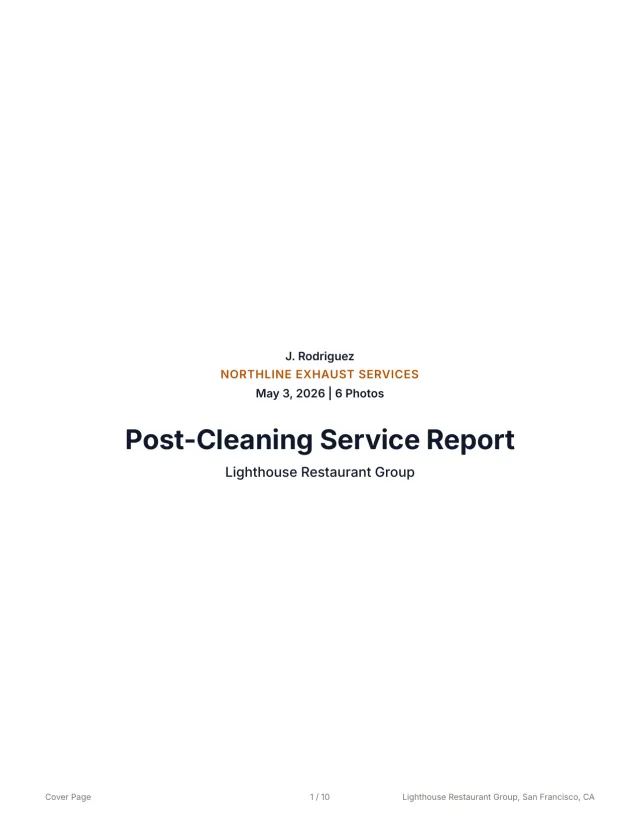 See a finished report The 10-page sample, the Certificate of Service, and the 3x5 sticker from one job.
 Related guides
Keep building the report record
Write missing access panel report notes that document inaccessible ducts, photo evidence, deficiencies, customer next steps, and customer-ready records.
Reporting Restaurant Hood Cleaning Report Template for Multi-Location AccountsUse this restaurant hood cleaning report template to document store details, hood systems, photos, deficiencies, service dates, PDFs, and account handoff.
Reporting Kitchen Exhaust Cleaning Report ExamplesUse kitchen exhaust cleaning report examples to structure job details, before-and-after photos, access notes, deficiencies, signoff, PDFs, and handoff.
Send your next job as a finished report.
Your photos become a branded report, a Certificate of Service, and a 3x5 sticker, under one job number.
3 reports or 3 days free. No card.