NFPA 96 kitchen hood requirements are not just about cleaning grease from a kitchen exhaust system. Contractors also need records that show what was inspected, what was cleaned, what could not be reached, and what the customer or authority having jurisdiction may need next.
In short, the documentation most crews need from NFPA 96 kitchen hood requirements is:
- Cleaning frequency from Table 11.4: monthly, quarterly, semiannual, or annual based on cooking type and volume.
- Bare metal: accessible grease films should be removed so the cleaned surface is essentially free of deposits.
- Service label: a hood or system label that records who cleaned it, the service date, and the next due date.
- Access panels: openings that let the crew reach ducts and fans, plus a record of any missing or blocked access.
- Structured notes: scope, inaccessible areas, deficiencies, and photos that match those four points.
This guide focuses on documentation. It is written for kitchen exhaust cleaning contractors who need practical, structured service records without claiming that one report guarantees compliance. HoodCleaningReport is a documentation tool. It does not certify work, determine compliance, or guarantee approval by an AHJ, insurer, or customer.
For the field-by-field documentation behind the report, use the NFPA 96 hood cleaning report documentation guide. For a job-level field checklist, use the NFPA 96 inspection checklist guide and the NFPA 96 checklist generator.
For fire marshal and AHJ handoff questions, use what fire marshals look for in a hood cleaning report. For commercial kitchen hood cleaning code requirements beyond NFPA 96 documentation fields, use that checklist instead of this page.
NFPA 96 documentation starts with scope
NFPA describes NFPA 96 as the standard for ventilation control and fire protection of commercial cooking operations. In practice, that means the exhaust system record needs to make the job scope clear before anyone looks at the photos or notes.
Document:
- Customer name and service location
- Service date and crew or technician name
- Hood line, cookline, or system name
- Areas inspected
- Areas cleaned
- Areas excluded from service
- Fan location and duct access points used
- Job type, such as routine cleaning, inspection, re-clean, or deficiency follow-up
If the kitchen has multiple hoods or multiple exhaust fans, separate the documentation by system. A single combined note can create confusion when the customer, inspector, or property manager asks which duct or fan was serviced.
Inspection report requirements
An inspection record should show the condition of the system and any limits on what the crew could verify.
Include:
- Areas with visible grease accumulation
- Areas that were inspected and found acceptable
- Inaccessible areas that could not be inspected
- Accessible areas that were not inspected and why
- Locations of access panels used
- Damaged, leaking, missing, or unsafe components
- Photos that identify the condition found
Do not hide access limits in general notes. If a duct section, fan, or access point could not be inspected, list it clearly. That protects the contractor and gives the customer a specific issue to resolve.
Cleaning report requirements
The cleaning report should prove the completed work, not just say the system was cleaned.
Include:
- Date of cleaning
- Technician or crew name
- Service company name and contact information
- Hood, plenum, filters, ducts, fan, fan curb, and rooftop areas cleaned
- Inaccessible areas that were not cleaned
- Accessible areas that were not cleaned and why
- Access panel locations
- Visible duct leakage or leaking access panels
- Before-and-after photos
- Customer handoff notes
Use plain language. “Cleaned hood, vertical duct access, fan bowl, fan blades, and curb” is stronger than “service complete.” The more specific report is easier for an owner or reviewer to understand months later.
Inaccessible areas need their own section
Inaccessible-area documentation is one of the most important parts of an NFPA 96 hood cleaning record because it explains what the crew could not verify or clean.
Common examples include:
- Missing duct access panels
- Access panels blocked by equipment or construction
- Locked roof access
- Exhaust fan that cannot be safely opened
- Unsafe roof or ladder conditions
- Concealed duct sections with no approved access
- Customer-declined access or repair work
Write the note so the customer can act on it:
Rear cookline duct section above ceiling could not be inspected or cleaned because no access panel was available. Recommend approved duct access before the next service.
That note identifies the area, explains the limit, and gives the customer a next step.
For access-specific deficiency notes and photos, use the guide to documenting missing access panels in a hood cleaning report.
Access panel records
Access panels are not just a field convenience. They are part of the record that shows how the crew reached the exhaust path.
For each access point used, document:
- Location
- Whether it was opened
- Before condition
- After condition
- Any damage, leakage, or gasket issue
- Whether a service label or tag was applied where required
Photos help here. A labeled photo of the access panel location can answer questions that a short note cannot.
Deficiency documentation
Deficiencies should be separated from completed work. A customer should be able to scan the report and see which items need action.
For each deficiency, include:
- Component or location
- Condition found
- Why it matters operationally
- Photo evidence
- Recommended next step
- Whether follow-up service is needed
Examples:
- Missing access panel above rear cookline
- Damaged or missing grease filters
- Fan hinge or hold-open issue
- Grease containment overflow
- Leaking access panel
- Unsafe electrical condition near the fan
- Heavy grease in an area not included in the approved scope
Keep the language factual. Avoid overstating code conclusions unless your team is qualified and the local AHJ agrees with the interpretation.
Photo evidence
Photos are often the fastest way to make a hood cleaning report credible.
Capture:
- Hood plenum before and after
- Filters before and after
- Duct access openings before and after
- Fan bowl before and after
- Fan blades before and after
- Fan curb and rooftop grease conditions
- Grease containment
- Deficiencies
- Inaccessible or unsafe areas
Label the photos by system and component. “Main cookline fan bowl after cleaning” is more useful than a timestamped image with no context.
Cleaning frequency notes
NFPA 96 documentation often leads to the same customer question: when should this kitchen be cleaned again?
Your report should record:
- Current cleaning interval
- Recommended next service date
- Reason for any frequency change
- Cooking load observed during service
- Solid fuel, charbroiler, wok, 24-hour, or high-volume operation notes
- Customer or AHJ requirement if stricter than your normal recommendation
The report does not need to argue with the customer. It should make the recommendation visible and easy to reference.
For examples of monthly, quarterly, semiannual, and annual interval notes, read Kitchen Exhaust Cleaning Frequency: How to Explain the Next Service Date.
Customer and AHJ handoff
A useful report should be ready to send after the job closes.
Finish with:
- Technician completion notes
- Customer acknowledgement or signoff
- Report issue date
- Contractor contact information
- PDF download or permanent share link
- Related deficiency photos and notes
- Next service recommendation
Some jurisdictions or customers may require reports to be submitted directly, uploaded into a portal, or stored for a specific period. Confirm local AHJ rules instead of assuming one handoff process works everywhere.
What not to claim
Be careful with compliance language. A report can support documentation, but it should not promise more than it proves.
Avoid claims like:
- “NFPA certified”
- “Guaranteed compliant”
- “Approved by NFPA”
- “No further inspection needed”
- “This replaces the standard”
Use defensible language instead:
- “Documents the completed service”
- “Supports structured service records”
- “Identifies inaccessible areas and deficiencies”
- “Helps the customer keep a clear service record”
- “Confirm current requirements with the authority having jurisdiction”
For credential wording, use hood cleaning certification, licenses, and service records so a service certificate does not get confused with technician certification or local license requirements.
Contractor documentation checklist
Before sending the report, confirm it includes:
- Job and customer details
- Exhaust system scope
- Inspection findings
- Cleaning work completed
- Inaccessible areas
- Access panel locations
- Deficiencies
- Before-and-after photos
- Cleaning frequency or next service date
- Technician notes
- Customer signoff
- PDF or share link
If any of those pieces are missing, the customer may still have questions when an inspector, insurer, or property manager asks for proof.
Create the report from the field notes
HoodCleaningReport helps kitchen exhaust cleaning contractors turn photos, deficiencies, access notes, frequency recommendations, and signoff into branded reports, PDFs, and client share links.
You can review a sample report, compare hood cleaning report software, see pricing, or create a hood cleaning report when you are ready to turn the checklist into a customer-facing record.
For the official standard text and current NFPA materials, use the NFPA 96 standard page and confirm the edition adopted by your local authority having jurisdiction.
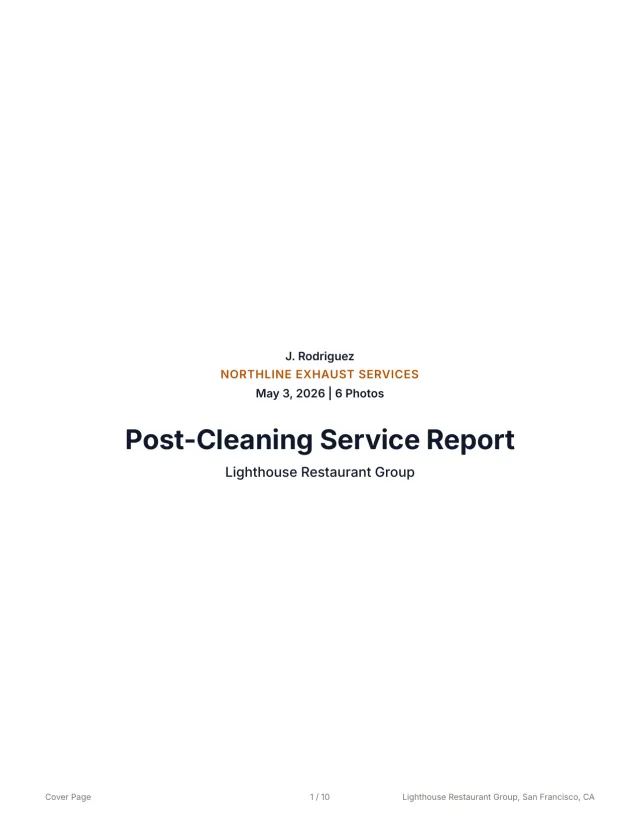 See a finished report The 10-page sample, the Certificate of Service, and the 3x5 sticker from one job.
 Related guides
Keep building the report record
Which states and cities require a license or certificate to clean kitchen exhaust systems, who issues it, and where the rules are written. Checked October 2026 against official sources.
Standards NFPA 96 Inspection Checklist for Kitchen Exhaust ContractorsUse this NFPA 96 inspection checklist to document kitchen exhaust scope, visible conditions, access, photos, deficiencies, frequency, and AHJ handoff.
Standards Commercial Kitchen Hood Cleaning Code Requirements ChecklistDocument commercial kitchen hood cleaning code requirements: scope, NFPA 96 records, access, deficiencies, photos, frequency, and AHJ handoff.
Send your next job as a finished report.
Your photos become a branded report, a Certificate of Service, and a 3x5 sticker, under one job number.
3 reports or 3 days free. No card.