Kitchen exhaust cleaning frequency should be easy for the customer to understand after every service visit. The report should state the current interval, the recommended next service date, and the reason that interval makes sense for the kitchen.
That explanation matters because restaurant managers, facility directors, property managers, and fire marshals may all review the same record later. A vague note like “clean again soon” does not help anyone. A clear frequency note connects the cooking operation, grease conditions, local requirements, and next service date in one place.
How often should commercial kitchen hoods be cleaned
NFPA 96 Table 11.4 is the usual starting point: monthly for systems serving solid-fuel cooking operations, quarterly for high-volume cooking such as 24-hour operations, charbroiling, and wok cooking, semiannually for moderate-volume cooking operations, and annually for low-volume operations such as churches, day camps, seasonal businesses, and similar kitchens. Treat the table as a planning aid, then shorten the interval if the customer, insurer, or authority having jurisdiction requires it, or if the grease load on this system is heavier than the category suggests. After you have the cooking profile, estimate the next service date with the kitchen exhaust cleaning frequency calculator.
Use this guide to document cleaning frequency in a way that is practical, customer-ready, and careful about compliance language. Build the working report with the free hood cleaning report template generator, then review the NFPA 96 report documentation guide.
Kitchen exhaust cleaning frequency
NFPA 96 cleaning frequency is commonly grouped into four service intervals based on cooking type and volume:
| Kitchen type | Common interval | Typical examples |
|---|---|---|
| Solid-fuel cooking | Monthly | Wood-fired ovens, charcoal broilers, solid-fuel cooking equipment |
| High-volume cooking | Quarterly | 24-hour cooking, charbroiling, wok cooking, heavy fryer volume |
| Moderate-volume cooking | Semiannually | Standard restaurant cooking at moderate volume |
| Low-volume cooking | Annually | Churches, day camps, seasonal businesses, senior centers, similar low-volume operations |
Treat those intervals as a starting point, not a substitute for the current standard, local code, customer contract, or authority having jurisdiction. Some customers and jurisdictions require more frequent service. Some systems need shorter intervals because the grease load is heavier than the schedule suggests.
The contractor’s report should make the recommendation visible and defensible without claiming that the schedule alone guarantees compliance.
Start with the kitchen type
The first question is not “How many seats does the restaurant have?” It is “What kind of grease load does this exhaust system see?”
Record the cooking operation in plain language:
- Solid fuel, such as wood or charcoal
- Charbroiler, wok, or high-heat cooking
- Heavy fryer use
- 24-hour or extended-hours cooking
- Moderate-volume line cooking
- Low-volume, seasonal, institutional, or occasional use
This gives the next service date context. A burger restaurant with charbroiling and heavy fryer use needs a different explanation than a church kitchen used a few times per month.
Monthly service: solid-fuel and very heavy use
Monthly service is the category customers often question because it sounds aggressive until the fire load is explained.
Document monthly recommendations when the system serves solid-fuel cooking or other very heavy-use conditions that require close attention. Examples include:
- Wood-fired pizza ovens
- Charcoal or solid-fuel broilers
- Heavy smoke and grease production
- Extended or around-the-clock cooking schedules
- Rapid grease accumulation observed during inspection
Report note example:
Recommend monthly kitchen exhaust cleaning because the main cookline includes solid-fuel cooking and visible grease accumulation was present before service. Next recommended service: July 27, 2026.
Keep the wording factual. The report should identify the operation and the observed condition, then give the next service date.
Quarterly service: high-volume cooking
Quarterly cleaning is common for busy restaurants with high grease production.
Use this interval when the kitchen has high-volume cooking operations such as:
- Charbroiling
- Wok cooking
- Heavy fryer volume
- Long daily operating hours
- Fast buildup between services
- Multi-shift restaurants or high-volume cafeterias
Report note example:
Recommend quarterly kitchen exhaust cleaning due to charbroiler and fryer volume on the main cookline. Fan bowl and plenum showed heavy grease before service. Next recommended service: September 27, 2026.
If the customer wants a longer interval, the report should still document what the crew observed. The office can follow up with the customer, but the field record should not soften a risk just to avoid a difficult conversation.
Semiannual service: moderate-volume cooking
Semiannual cleaning is often appropriate for moderate-volume kitchens that operate with standard cooking equipment and do not show heavy grease buildup between visits.
Examples may include:
- Moderate-volume sit-down restaurants
- School or facility kitchens with regular but controlled production
- Kitchens without solid fuel, charbroiling, wok cooking, or heavy fryer loads
- Systems that show manageable buildup on the current schedule
Report note example:
Recommend semiannual kitchen exhaust cleaning based on moderate cooking volume and current grease conditions observed during service. Next recommended service: December 27, 2026.
This note works only if the inspection supports it. If the crew finds heavy grease at the six-month mark, the report should recommend a shorter interval and explain why.
Annual service: low-volume cooking
Annual cleaning can fit low-volume operations, but contractors should be careful with this category. Low volume means the exhaust system truly sees limited grease-producing use.
Examples may include:
- Churches
- Day camps
- Seasonal facilities
- Senior centers
- Community rooms or occasional-use kitchens
Report note example:
Recommend annual kitchen exhaust cleaning based on low-volume seasonal use and light grease conditions observed during service. Next recommended service: June 27, 2027.
Do not use annual service as a default for small kitchens. A small restaurant can still produce heavy grease if the equipment and menu create the load.
When to shorten the interval
The schedule should change when the system tells you it needs to change.
Shorten the recommended interval when the crew finds:
- Heavy grease before the scheduled service date
- Grease deposits in the fan, duct, plenum, or access points
- Solid-fuel or high-volume cooking added since the last visit
- Longer operating hours
- Menu changes that add fryer, wok, or charbroiler volume
- Inaccessible duct sections that could not be verified
- Failed or missing grease containment
- Customer, insurer, landlord, or local AHJ requirements that are stricter than the normal schedule
The report should connect the change to a specific reason. “Move to quarterly service because heavy grease was found in EF-1 fan bowl after a six-month interval” is more useful than “Needs more frequent cleaning.”
When not to lengthen the interval
Customers may ask to stretch the schedule to reduce cost. Do not lengthen the interval just because the last visit looked acceptable.
Before recommending a longer interval, confirm:
- The system was fully accessible
- The crew inspected the hood, plenum, ducts, fan, and rooftop areas
- Photos support the condition notes
- The cooking equipment and hours have not changed
- Local AHJ or customer requirements allow the longer schedule
- The customer understands that visible grease or inspection findings can trigger earlier service
If any of those points are unclear, keep the existing interval and document why.
What to put in the service report
The frequency note should be its own field or section, not a sentence buried in general comments.
Include:
- Current cleaning interval
- Recommended next service date
- Recommended interval
- Cooking type or volume behind the recommendation
- Grease condition observed before service
- Local AHJ, insurer, landlord, or customer requirement if known
- Any reason the interval changed
- Inaccessible areas that could affect confidence in the recommendation
For field capture, add the frequency step to your commercial kitchen hood cleaning checklist. For compliance framing, pair it with the NFPA 96 hood cleaning requirements guide.
Frequency note examples
Use notes that a customer can understand without calling the office.
Monthly:
Recommend monthly service because the kitchen uses solid-fuel cooking equipment and grease accumulation was visible before cleaning. Next recommended service: July 27, 2026.
Quarterly:
Recommend quarterly service due to high-volume fryer and charbroiler use. Fan bowl and plenum had heavy buildup before cleaning. Next recommended service: September 27, 2026.
Semiannual:
Recommend semiannual service based on moderate-volume cooking and manageable grease conditions at this visit. Next recommended service: December 27, 2026.
Annual:
Recommend annual service based on low-volume seasonal use and light grease conditions observed during inspection. Next recommended service: June 27, 2027.
Shortened interval:
Recommend moving from semiannual to quarterly service because heavy grease was present in the main cookline plenum and EF-1 fan bowl before cleaning.
Access limitation:
Frequency recommendation is based on accessible areas only. Vertical duct section above the rear cookline could not be verified because no access panel was available.
Explain the next service date clearly
The next service date should be written as a date, not just an interval.
Use:
- “Next recommended service: September 27, 2026”
- “Current interval: quarterly”
- “Reason: high-volume fryer and charbroiler operation”
Avoid:
- “Due in 3 months”
- “Quarterly maybe”
- “As needed”
- “Customer will call”
Dates are easier for managers to schedule, easier for property teams to track, and easier for inspectors to understand later.
Final checklist
Before sending the report, confirm the frequency section answers the questions a customer will ask.
Check that:
- The report includes the current interval
- The report includes a specific next service date
- The kitchen type or cooking volume is documented
- Grease conditions are supported by photos
- Any interval change has a reason
- Any inaccessible area is clearly listed
- Local AHJ or customer requirements are noted when known
- The wording does not claim guaranteed compliance
The goal is a recommendation the customer can act on and a record your team can defend later.
HoodCleaningReport builds customer-ready reporting software for kitchen exhaust cleaning contractors. It turns job photos, cleaning frequency notes, deficiencies, access limits, and signoff into branded service reports, PDFs, client share links, and customer-ready records.
You can calculate a starting frequency, review a sample report, compare hood cleaning report software, or create a hood cleaning report when you are ready to turn the next service date into clear customer documentation.
Kitchen exhaust cleaning frequency FAQ
How often should a commercial hood system be cleaned?
The interval depends on the cooking operation, volume, fuel, grease conditions, adopted standard, local direction, customer requirements, and what the inspection shows. High-volume or solid-fuel operations generally need more frequent service than low-volume or seasonal kitchens. Record both the interval and the reason in the report.
Should the report show an interval or an exact date?
Show both. “Quarterly” explains the schedule. “Next recommended service: October 27, 2026” gives the restaurant manager or facility team a date they can act on and preserves the recommendation in the service history.
Can a calculator set the final cleaning frequency?
No. A calculator gives a documentation starting point. The contractor still needs to consider actual grease conditions, accessible areas, the current adopted standard, the AHJ, and any stricter contract, insurer, landlord, or customer requirement.
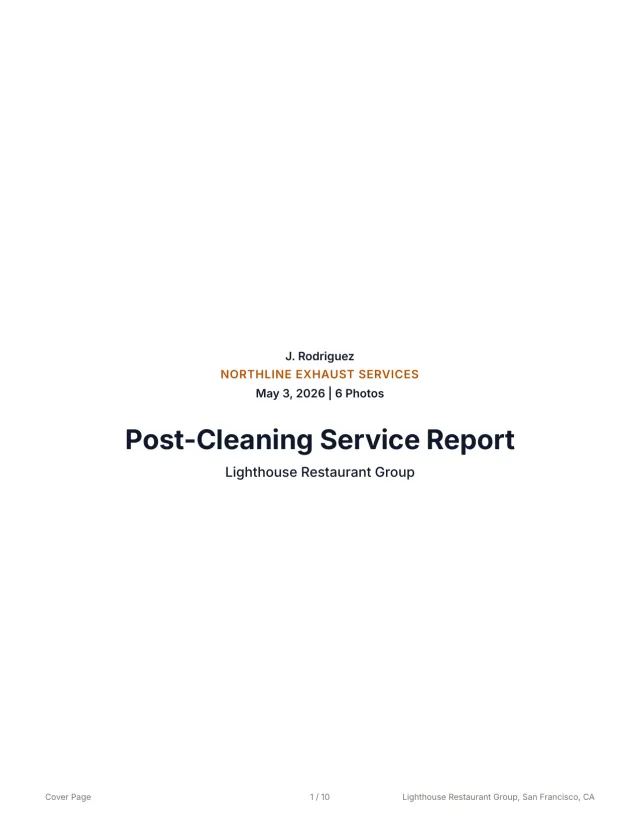 See a finished report The 10-page sample, the Certificate of Service, and the 3x5 sticker from one job.
 Related guides
Keep building the report record
Which states and cities require a license or certificate to clean kitchen exhaust systems, who issues it, and where the rules are written. Checked October 2026 against official sources.
Standards NFPA 96 Inspection Checklist for Kitchen Exhaust ContractorsUse this NFPA 96 inspection checklist to document kitchen exhaust scope, visible conditions, access, photos, deficiencies, frequency, and AHJ handoff.
Standards Commercial Kitchen Hood Cleaning Code Requirements ChecklistDocument commercial kitchen hood cleaning code requirements: scope, NFPA 96 records, access, deficiencies, photos, frequency, and AHJ handoff.
Send your next job as a finished report.
Your photos become a branded report, a Certificate of Service, and a 3x5 sticker, under one job number.
3 reports or 3 days free. No card.