When a fire marshal asks for hood cleaning documentation, the contractor needs more than a receipt.
The useful record shows what system was serviced, what the crew cleaned, what could not be reached, what deficiencies remain, and when the customer should schedule the next service.
Keyword research showed no usable related-keyword expansion for the exact seed “fire marshal hood cleaning requirements.” That does not mean the objection is unimportant. It means contractors should cover it as a practical documentation page tied to stronger clusters: hood cleaning reports, NFPA 96 requirements, code requirements, and cleaning frequency.
For the official standard source, start with the NFPA 96 standard page. NFPA describes the standard as covering ventilation control and fire protection for commercial cooking operations, including design, installation, inspection, and related requirements. Always confirm the edition adopted by the authority having jurisdiction.
Start with the service identity
The first job of the report is to prove which work order the record belongs to.
Include:
- Customer name
- Service location name
- Full address
- Service date
- Arrival and completion time
- Technician or crew name
- Job number, invoice number, or work order ID
- Hood line, cookline, or exhaust system name
If the customer has several hoods, document each system separately. A vague “kitchen hood cleaned” note creates avoidable questions.
Show the inspected and cleaned scope
A fire marshal or AHJ may want to understand what part of the system the crew actually touched.
A strong report lists:
- Hood canopy
- Grease filters or baffles
- Plenum
- Duct access points
- Exhaust fan bowl and blades
- Fan curb and rooftop area
- Grease containment
- Fire suppression observations, if visible and in scope
Do not let scope hide inside photo captions. Put it in a dedicated section so the customer can scan it quickly.
Label before-and-after photos
Photos are only useful when the reader knows what they show.
Capture and label:
- Hood interior before and after
- Plenum before and after
- Duct access before and after
- Fan bowl before and after
- Fan blades before and after
- Rooftop grease condition
- Inaccessible or unsafe areas
- Deficiencies that need follow-up
Use component names in captions. “Main cookline fan bowl after cleaning” is stronger than a timestamped image with no context.
Separate inaccessible areas
Inaccessible areas deserve their own section because they define the limits of the work.
Common examples:
- Missing duct access panel
- Blocked access panel
- Locked roof access
- Fan that cannot be opened safely
- Unsafe roof or ladder condition
- Concealed duct section with no access
- Customer declined repair or access work
Write the note so the customer can act on it:
Rear cookline duct section above ceiling could not be inspected or cleaned because no access panel was available. Recommend approved access before the next service.
That note identifies the location, the reason, and the next step.
Keep deficiencies out of general notes
Deficiencies should not be buried inside a paragraph.
For each deficiency, include:
- Component or location
- Condition found
- Photo evidence
- Why it matters operationally
- Recommended next step
- Whether follow-up service is required
Keep the language factual. Avoid claiming code conclusions unless your team is qualified and the local AHJ agrees with the interpretation.
Include cleaning frequency
Search data shows stronger demand around frequency questions than many exact report terms. That matches what customers ask after service: “When do we need to clean this again?”
The report should include:
- Current cleaning interval
- Recommended next service date
- Reason for the recommendation
- Cooking load or special condition notes
- Customer or AHJ requirement if stricter than normal
For a detailed interval workflow, use the kitchen exhaust cleaning frequency calculator.
Finish with a handoff record
The final section should make the report easy to retrieve later.
Include:
- Technician completion statement
- Customer representative name
- Customer signoff, if captured
- Issue date
- Contractor contact information
- PDF download or permanent share link
- Any open deficiencies or return-visit notes
A clean handoff reduces calls from customers who cannot find the record when an inspector asks.
What the report should not claim
A report can support customer-ready documentation. It should not overpromise.
Avoid:
- “NFPA certified”
- “Guaranteed compliant”
- “Approved by NFPA”
- “Fire marshal approved”
- “No further inspection needed”
Use defensible language:
- “Documents the completed service”
- “Lists inaccessible areas and deficiencies”
- “Supports customer and AHJ recordkeeping”
- “Confirm local requirements with the authority having jurisdiction”
Build the record once
HoodCleaningReport helps kitchen exhaust cleaning contractors turn job photos, deficiencies, access notes, frequency recommendations, and customer signoff into branded PDFs and share links.
Review the sample hood cleaning report, use the NFPA 96 checklist generator, compare hood cleaning report software, or create your first report when you are ready to standardize the handoff.
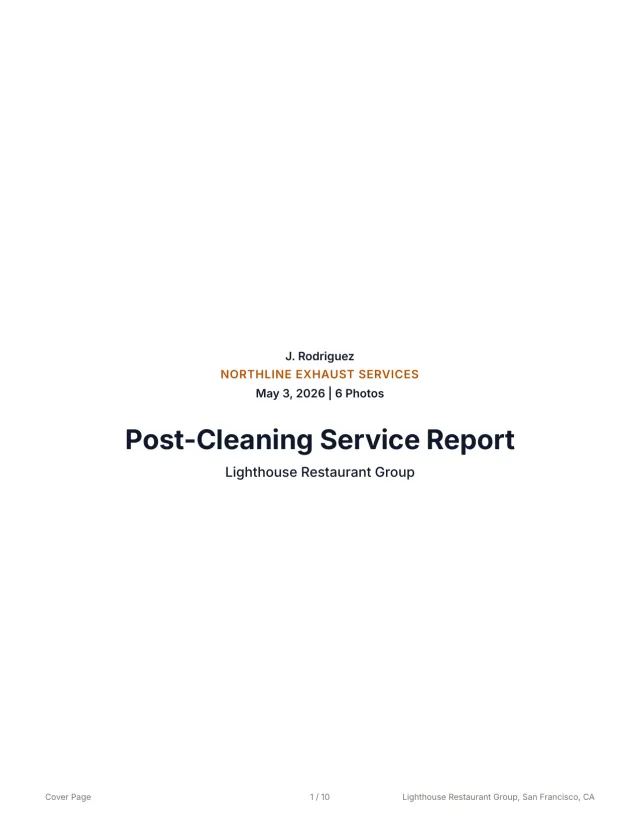 See a finished report The 10-page sample, the Certificate of Service, and the 3x5 sticker from one job.
 Related guides
Keep building the report record
Which states and cities require a license or certificate to clean kitchen exhaust systems, who issues it, and where the rules are written. Checked October 2026 against official sources.
Standards NFPA 96 Inspection Checklist for Kitchen Exhaust ContractorsUse this NFPA 96 inspection checklist to document kitchen exhaust scope, visible conditions, access, photos, deficiencies, frequency, and AHJ handoff.
Standards Commercial Kitchen Hood Cleaning Code Requirements ChecklistDocument commercial kitchen hood cleaning code requirements: scope, NFPA 96 records, access, deficiencies, photos, frequency, and AHJ handoff.
Send your next job as a finished report.
Your photos become a branded report, a Certificate of Service, and a 3x5 sticker, under one job number.
3 reports or 3 days free. No card.