Kitchen exhaust cleaning report examples are useful because they show what a customer, fire marshal, insurer, or property manager actually needs after the cleaning is finished.
A strong report is not a loose photo dump or a one-line invoice note. It should explain the location, the hood system, what was cleaned, what could not be accessed, what deficiencies were found, and what evidence supports the service record.
Use these examples to tighten your own report workflow. If you want the full field list first, start with the hood cleaning inspection report checklist, generate a free report PDF preview, or compare against this sample hood cleaning report PDF.
Kitchen exhaust cleaning report examples
The best kitchen exhaust cleaning reports follow the same basic structure every time:
- Customer and location details
- Service date, work order, and crew
- Hood system or fan identification
- Cleaning scope
- Before-and-after photos
- Access limitations
- Deficiencies and recommendations
- Service frequency and next recommended date
- Customer acknowledgement
- PDF or share-link handoff
The examples below are not legal advice, code approval, or a substitute for the current NFPA 96 standard, local authority requirements, or professional judgment. They are practical examples of how contractors can document the work clearly.
Example 1: Standard restaurant service report
This is the most common report type for a routine restaurant kitchen exhaust cleaning job.
Use it when:
- One location was serviced
- The crew cleaned the scheduled hood system
- Before-and-after photos were captured
- No major access issues blocked the work
- The customer needs a PDF for their inspection binder
Useful report fields:
| Section | Example content |
|---|---|
| Customer | ”Harbor Grill - 245 West Main Street” |
| System | ”Main cookline hood, EF-1 roof fan” |
| Service date | ”July 8, 2026” |
| Work completed | ”Cleaned hood interior, plenum, filters, accessible duct opening, fan bowl, fan blades, fan curb, and rooftop grease area.” |
| Photos | ”Before and after photos attached for hood, plenum, duct access, fan bowl, fan blades, and rooftop area.” |
| Next service | ”Next service recommended in 90 days based on current schedule and observed cooking volume.” |
Example note:
Service completed for the main cookline hood and EF-1. Accessible areas were cleaned and before-and-after photos are included. No inaccessible areas were reported by the crew for this scheduled scope.
This example works because it identifies the specific system and describes the accessible areas cleaned. It does not just say “hood cleaned.”
Example 2: Report with a deficiency
Deficiencies should be easy to find in the report. Do not bury them in a general notes field or leave them only in a photo caption.
Use it when the crew finds:
- Missing or damaged fan hinges
- Damaged filters
- Broken access panels
- Leaking duct access covers
- Grease containment issues
- Unsafe fan wiring or loose fan components
- Heavy grease outside the approved cleaning scope
Useful deficiency fields:
| Field | Example |
|---|---|
| Component | ”EF-2 roof fan” |
| Condition | ”Fan hinge hardware missing” |
| Impact | ”Fan could not be opened safely for full inspection of the fan bowl.” |
| Photo | ”Photo attached showing missing hinge hardware.” |
| Recommendation | ”Recommend approved hinge repair before next service.” |
Example note:
EF-2 fan hinge hardware is missing. The fan could not be opened safely, so the fan bowl condition could not be fully verified. Recommend approved hinge repair before next service. Photo attached.
This note is stronger than “fan problem” because it explains the component, condition, limit, and recommended next step.
For more field language, use the hood cleaning report PDF checklist.
Example 3: Report with an inaccessible area
Inaccessible areas are one of the most important parts of the report because they explain what your crew could not verify or clean.
Common reasons include:
- Missing access panel
- Blocked access opening
- Locked roof access
- Unsafe roof or ladder condition
- Fan that cannot be opened safely
- Concealed duct section with no approved access
- Customer declined added scope or repair
Example note:
Rear duct section above the prep line could not be inspected or cleaned because no access panel was available. Recommend approved access before next scheduled service.
Useful photo evidence:
- Location of the inaccessible duct section
- Ceiling, wall, or chase where access was unavailable
- Fan or access cover that could not be opened
- Any customer-provided access restriction
Avoid vague wording like:
No access.
That note does not tell the customer which area was limited, why it was limited, or what they should do next.
For field capture, pair this report type with the commercial kitchen hood cleaning checklist for crews.
Example 4: Multi-system kitchen exhaust cleaning report
Some restaurants have more than one hood system. If the report blends them together, it becomes hard to prove what happened on each system.
Use a separate section for each system:
- Main cookline hood and EF-1
- Prep hood and EF-2
- Dishwasher hood
- Pizza oven hood
- Charbroiler hood
- Additional duct access points
Example structure:
| System | Work completed | Photos | Notes |
|---|---|---|---|
| Main cookline hood / EF-1 | Hood, plenum, filters, duct access, fan bowl, fan blades | Before and after photos included | No deficiencies noted in accessible areas |
| Prep hood / EF-2 | Hood, filters, accessible duct opening | Before and after photos included | Duct access cover gasket damaged; replacement recommended |
This format helps office staff, inspectors, and facility managers understand the job without guessing which photos belong to which hood.
If your crews often service multiple systems, use consistent system names on every report. “EF-1” and “main cookline fan” should not randomly switch from job to job unless the customer uses both labels.
Example 5: Customer-ready PDF handoff
The finished report should be easy for the customer to forward, upload, print, or retrieve later.
A customer-ready handoff includes:
- Branded PDF
- Share link
- Short summary email
- Deficiency callout when needed
- Next recommended service date
- Contractor contact information
Example handoff summary:
Attached is the kitchen exhaust cleaning report for Harbor Grill, completed July 8, 2026. The report includes before-and-after photos, completed work notes, and the next recommended service date. One deficiency was documented for EF-2 fan hinge hardware; photos and the recommended next step are included in the report.
The email summary should not replace the report. It should help the customer understand what to look for inside the PDF.
For the PDF structure, review hood cleaning report PDF: what your customer should receive.
What every example has in common
Good reports are specific. They document the job in a way that someone can understand weeks or months later.
Every kitchen exhaust cleaning report should answer:
- Who was the customer?
- Which location was serviced?
- Which hood system was cleaned?
- What work was completed?
- What photos prove the before-and-after condition?
- What could not be accessed?
- What deficiencies need attention?
- When should the next service happen?
- Who received or acknowledged the report?
If a report cannot answer those questions, the office will usually have to reconstruct the job from texts, camera rolls, invoices, and technician memory.
Example wording to avoid
Weak report language creates follow-up calls and inspection confusion.
Avoid:
- “Cleaned hood”
- “All good”
- “Fan issue”
- “No access”
- “See photos”
- “Compliant”
- “NFPA approved”
- “Certified fire safe”
Use factual language instead:
- “Accessible areas cleaned”
- “Before-and-after photos attached”
- “Access limitation documented”
- “Deficiency observed”
- “Recommended next step”
- “Next service recommended”
The report can document service work and observations. It should not overstate what the report proves.
Turn examples into a repeatable workflow
Examples are useful, but the real value comes from making every crew produce the same kind of report.
Standardize:
- Required job fields
- System names
- Photo sections
- Deficiency categories
- Access limitation language
- Next service recommendations
- Customer acknowledgement
- PDF handoff
HoodCleaningReport is built for kitchen exhaust cleaning contractors who need that workflow after every job. It turns job details, before-and-after photos, access notes, deficiencies, service frequency, and signoff into branded reports, PDFs, share links, and customer-ready records.
You can review a sample hood cleaning report PDF, compare hood cleaning report software, view pricing, or create a kitchen exhaust cleaning report for your next completed job.
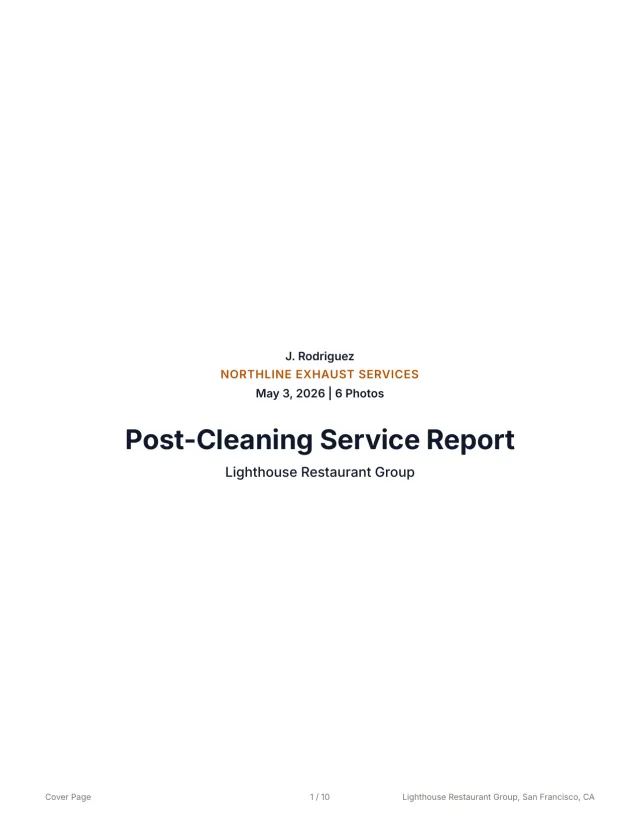 See a finished report The 10-page sample, the Certificate of Service, and the 3x5 sticker from one job.
 Related guides
Keep building the report record
Write missing access panel report notes that document inaccessible ducts, photo evidence, deficiencies, customer next steps, and customer-ready records.
Reporting Restaurant Hood Cleaning Report Template for Multi-Location AccountsUse this restaurant hood cleaning report template to document store details, hood systems, photos, deficiencies, service dates, PDFs, and account handoff.
Reporting Hood Cleaning Report PDF: What Your Customer Should ReceiveLearn what a hood cleaning report PDF should include: job details, photos, access notes, deficiencies, next service date, signoff, and a shareable record.
Send your next job as a finished report.
Your photos become a branded report, a Certificate of Service, and a 3x5 sticker, under one job number.
3 reports or 3 days free. No card.