Commercial kitchen hood cleaning code requirements usually lead to one practical contractor question: what should the crew document after a kitchen exhaust cleaning job?
The short answer is to identify the exact exhaust system, record what the crew inspected and cleaned, disclose access limits and excluded areas, document deficiencies, attach labeled before-and-after photos, and state the next-service recommendation. The exact legal and contractual requirements depend on the locally adopted code and edition, the authority having jurisdiction (AHJ), the facility, the customer contract, and the approved scope of work.
NFPA 96 addresses ventilation control and fire protection for commercial cooking operations. This guide only explains how to document cleaning work. It is not legal advice, a compliance determination, or a substitute for the adopted standard, local code, a qualified inspection, or AHJ direction.
Direct answer: what should the service record document?
A useful commercial kitchen hood cleaning record should show:
- Customer, location, service date, and the specific hood or exhaust system
- Areas inspected, areas cleaned, and components included in the work
- Inaccessible areas, access-panel issues, and scope exclusions
- Deficiencies, supporting photos, and recommended next steps
- Labeled before-and-after photos tied to the correct component
- Cleaning interval and recommended next service date
- Servicing company, crew, and applicable credentials
- Customer acknowledgement plus a durable PDF or share link
These fields help a customer or AHJ review the service. They do not prove that the system complies with every applicable requirement. Confirm the adopted edition, local amendments, required forms or tags, and submission rules with the AHJ.
Turn the list into a job record: build the field checklist, create a report template, calculate the cleaning interval, or review a sample report PDF.
What determines commercial kitchen hood cleaning code requirements?
“Code requirements” are not one fixed list for every kitchen. The controlling rules and recordkeeping expectations can vary by jurisdiction, facility, contract, and scope.
A contractor should confirm:
- The adopted edition of NFPA 96 or other applicable standard
- Local amendments or fire prevention rules
- AHJ inspection and submission expectations
- Customer contract requirements
- Property manager or insurer recordkeeping rules
- State or local license and credential requirements
- Whether fire suppression work is outside the hood cleaning scope
The service report should not claim to solve every code issue. It should document the job clearly enough that the customer can understand what was cleaned, what was not reached, what remains open, and what needs local review.
Start with the authority having jurisdiction
The designated authority having jurisdiction interprets and enforces the adopted requirements locally. In many cases, that may be the fire marshal or fire prevention office. A campus, corporate safety team, insurer, landlord, or government agency may set additional contractual or facility rules, but those rules are not a substitute for AHJ direction.
Before creating a customer record, confirm:
- Whether the report needs to be sent directly to anyone
- Whether service tags, stickers, or labels are required, and in what format (a hood cleaning sticker template covers the common 3x5 label)
- Whether access limitations need specific wording
- Whether deficiencies require follow-up documentation
- Whether cleaning frequency is set by cooking load, customer rules, or local direction
- Whether technician credentials or license numbers need to appear on the report
If those details are unknown, write the report in factual language and tell the customer to verify local submission rules with the AHJ.
Document the hood system scope
Commercial kitchen hood code requirements are easier to discuss when the report identifies the exact system.
For each hood line or exhaust system, document:
- Customer and location name
- Service date
- Hood, cookline, or system name
- Number of filters
- Fan ID or roof location
- Areas inspected
- Areas cleaned
- Areas excluded from scope
- Duct access points used
- Technician or crew lead
Do not rely on a single note that says “kitchen hood cleaned.” A customer with multiple cooklines needs to know which hood, duct, fan, and rooftop area the report covers.
Document completed cleaning
The report should name the components cleaned. This makes the service record easier to defend months later.
Include:
- Hood interior
- Plenum
- Filters or baffles
- Grease troughs and cups
- Accessible duct sections
- Duct access openings
- Exhaust fan bowl
- Fan blades
- Fan curb
- Rooftop grease area
- Grease containment when included in scope
Use specific language:
Cleaned main cookline hood, plenum, filters, vertical duct access, fan bowl, fan blades, fan curb, and accessible rooftop grease area. Before-and-after photos attached.
That note is stronger than “completed hood cleaning” because it tells the customer what the crew actually serviced.
Document access panels and inaccessible areas
Access is one of the places where code conversations become practical. If the crew cannot reach a duct section, the report should explain the limitation clearly.
Common access issues include:
- Missing duct access panel
- Blocked access panel
- Access panel that leaks or will not seal
- Concealed duct section with no approved access
- Locked roof access
- Fan that cannot be opened safely
- Unsafe ladder, roof, or electrical condition
- Customer declined access or repair work
Write the note so the customer can act on it:
Rear horizontal duct section above the prep ceiling could not be inspected or cleaned because no access panel was available. Recommend approved access installation and follow-up inspection or cleaning.
For more examples, use how to document missing access panels in a hood cleaning report or the hood cleaning deficiency note generator.
Keep deficiencies separate
Deficiencies should not be buried in general technician comments. A code-requirements documentation checklist should make open items visible.
For each deficiency, document:
- Component or location
- Condition observed
- Photo evidence
- Why it affects access, cleaning, safety, or operation
- Recommended next step
- Whether follow-up work is needed
- Who was notified, if known
Common examples:
- Missing access panels
- Damaged filters
- Leaking access panels
- Fan hinge or hold-open issue
- Grease containment problem
- Excessive rooftop grease
- Unsafe fan wiring or fan condition observed during cleaning
- Heavy grease in an area excluded from the approved scope
Keep the wording factual. Unless your team is qualified and the AHJ agrees with the interpretation, avoid turning an observation into a legal conclusion.
Capture photo evidence
Photos help prove the condition before cleaning, the work completed, and the condition after cleaning.
Capture and label:
- Hood interior before and after
- Plenum before and after
- Filters before and after
- Duct access before and after
- Fan bowl before and after
- Fan blades before and after
- Fan curb and roof area
- Grease containment
- Access limitations
- Deficiencies
The label matters. “EF-1 fan bowl after cleaning” gives the reader more value than a file name or timestamp.
Use the hood cleaning photo checklist generator if crews need a repeatable shot list.
Include cleaning frequency and next service date
Code and standards conversations often lead to the same customer question: how often should this commercial kitchen hood be cleaned?
The report should include:
- Current cleaning interval
- Recommended next service date
- Reason for the recommendation
- Cooking load or operation type
- Solid fuel, wok, charbroiler, high-volume, 24-hour, or seasonal notes
- Customer or AHJ requirement if stricter than the normal schedule
Do not hide the next service date in a separate email. Put it in the report so the customer can find it when an inspector asks.
For customer-facing interval language, use the kitchen exhaust cleaning frequency calculator.
Add credentials only when they are accurate
Some commercial kitchen hood code requirements searches overlap with license and certification questions. Add credentials to the report when they apply, but do not overstate them.
Useful fields may include:
- Company license or registration number
- Technician credential
- State-specific license field
- Certification renewal date
- Insurance or vendor identifier when the customer requires it
Avoid language that implies the report itself certifies compliance. For a careful explanation, read hood cleaning certification, licenses, and service records.
Use a report, not just a checklist
A printable commercial kitchen cleaning checklist can help crews remember tasks, but the customer needs a finished service record.
The final report should include:
- Job and customer details
- Hood system scope
- Completed cleaning notes
- Before-and-after photos
- Access panel notes
- Inaccessible areas
- Deficiencies and recommendations
- Cleaning frequency and next service date
- Technician notes
- Customer acknowledgement
- PDF or share link
Use the hood cleaning report template generator to build the structure before the job becomes a PDF.
What not to claim
Avoid code language that says more than the record proves.
Do not write:
- “Guaranteed compliant”
- “Fire marshal approved”
- “NFPA approved”
- “No further inspection required”
- “All concealed areas cleaned” when access was limited
- “No deficiencies exist” unless the report clearly documents the inspection scope behind that statement
Use defensible language:
- “Documents the completed service”
- “Accessible areas cleaned”
- “Access limitation noted”
- “Deficiencies documented”
- “Supports customer and AHJ recordkeeping”
- “Confirm local requirements with the authority having jurisdiction”
Final documentation checklist
Before sending a commercial kitchen hood cleaning report, confirm it answers the questions a customer or AHJ may ask later.
Check that the report includes:
- Customer, location, and service date
- Hood line, cookline, or exhaust system name
- Areas inspected and cleaned
- Areas not accessed or excluded from scope
- Access panel details
- Before-and-after photos
- Deficiencies and recommended next steps
- Cleaning frequency and next service date
- Technician or credential fields when applicable
- Customer acknowledgement
- PDF download or durable share link
HoodCleaningReport helps kitchen exhaust cleaning contractors turn job photos, code-sensitive notes, deficiencies, access limits, frequency recommendations, and signoff into branded reports, PDFs, and customer share links.
You can use the NFPA 96 checklist generator, build a report template, review a sample report PDF, or create your first hood cleaning report.
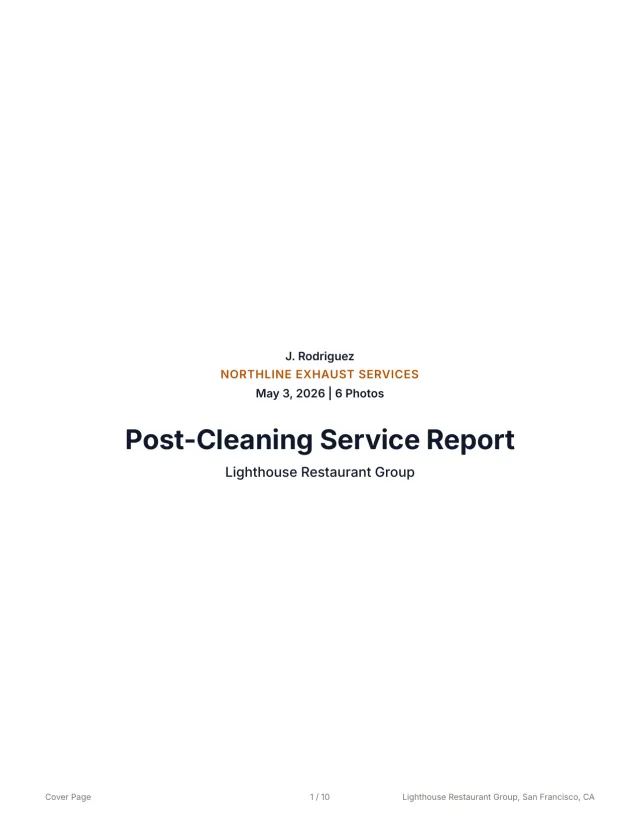 See a finished report The 10-page sample, the Certificate of Service, and the 3x5 sticker from one job.
 Related guides
Keep building the report record
Which states and cities require a license or certificate to clean kitchen exhaust systems, who issues it, and where the rules are written. Checked October 2026 against official sources.
Standards NFPA 96 Inspection Checklist for Kitchen Exhaust ContractorsUse this NFPA 96 inspection checklist to document kitchen exhaust scope, visible conditions, access, photos, deficiencies, frequency, and AHJ handoff.
Standards Hood Cleaning Certification, Licenses, and Service RecordsCompare hood cleaning certification, licenses, costs, online training, NFPA 96 documentation, certificates, and service records for contractors.
Send your next job as a finished report.
Your photos become a branded report, a Certificate of Service, and a 3x5 sticker, under one job number.
3 reports or 3 days free. No card.