Most states do not issue a license just for cleaning kitchen exhaust systems. A few places do, and they are strict about it: Massachusetts, New York City, and soon Rhode Island.
Everywhere else, the rules come from the fire code the state adopts, which points to NFPA 96. NFPA 96 says the cleaning is done by properly trained, qualified and certified people who are acceptable to the authority having jurisdiction. In practice, the local fire official decides what counts as qualified, and many accept industry programs such as IKECA’s.
This page lists what we found for the states our customers work in, with the official source for each. We checked every source in October 2026. Rules change, so open the source before you rely on it, and call the local fire marshal when you start work in a new town.
The short answer
| Place | License specific to hood cleaning? | Who issues it |
|---|---|---|
| Massachusetts | Yes, for the person and the company | Department of Fire Services |
| New York City | Yes, for the company and each technician | FDNY |
| Rhode Island | Passed in 2026, not yet in force | State Fire Marshal |
| Connecticut | No state license found | Local fire marshal enforces the fire code |
| New York State (outside NYC) | No state license found | Local code enforcement |
| New Jersey | No state license found | Local fire official |
| Pennsylvania | No state license found | Each municipality |
| Texas | No license found for cleaning | State Fire Marshal licenses suppression work only |
| Florida | No state license found | Local fire official |
| California | No state license found | Local fire officials |
“No state license found” means we found no license specific to hood cleaning in the state’s statutes, codes or fire marshal pages. Cities and counties can still add their own registration, permit or form.
Massachusetts
Massachusetts licenses both the people and the companies that clean and inspect commercial kitchen exhaust systems, through the Department of Fire Services.
- Each person needs a Certificate of Competency, earned by a written exam and good for three years. Type 1 is unrestricted, needs 500 hours of field work, and is the only type that may inspect. Type 2 is limited to cleaning systems you or your employer own.
- Each company needs a Certificate of Registration for each location, good for two years. This has applied since January 1, 2018.
- The fire code (527 CMR 1.00, Chapter 50) sets the inspection frequency and prescribes the hood label, at least 4.25 by 5.5 inches. It also requires notice of a non-compliant system to the fire department within 48 hours, and three years of records.
- Boston adds its own city registration.
Sources: Commercial cooking exhaust system inspections and hood cleaning and Apply for commercial hood cleaning and inspection licenses, both from Mass.gov.
A 3x5 sticker is too small for Massachusetts. Use the state’s label.
New York City
FDNY requires two credentials:
- The company needs a Commercial Cooking Exhaust System Servicing Company Certificate. Its principal needs five years of field experience and a W-64 or P-64 Certificate of Fitness. The company must keep insurance on file to stay on FDNY’s approved list, and the certificate lasts one year.
- Each technician needs a Certificate of Fitness: W-64 for work anywhere in the city, F-64 for a single premises, or P-64, which adds precipitators.
FDNY also says commercial cooking exhaust systems must be inspected and cleaned at least every three months, and sets its own rangehood decal rules.
Sources: FDNY pages for the servicing company certificate, the W-64 and the F-64.
Rhode Island
Rhode Island passed a Commercial Kitchen Exhaust System Inspection and Cleaning Licensing and Certification Act in 2026 (bills H 7857 and S 2647). The bill text calls for a State Fire Marshal license for each company and a certificate by exam for each technician, both good for three years.
The two bills give different start dates, July 1, 2027 and January 1, 2029, and we could not confirm the final signed text. Read the bill text (S 2647, H 7857) and confirm the start date with the State Fire Marshal before you plan around it.
Connecticut
We found no state license specific to hood cleaning. The Connecticut State Fire Prevention Code is based on NFPA 1 and points to NFPA 96. A state training handout says inspection and cleaning must be done by properly trained and qualified people. The local fire marshal enforces it.
Sources: CT fire safety and prevention codes and the commercial cooking handout, both from CT.gov. We could not search the state statutes directly, so a recent bill is not ruled out.
New York State, outside New York City
We found no state license. The Fire Code of New York State (section 607) says inspections are done by qualified individuals and cleaning follows ANSI/IKECA C10. It also says records name the individual and the company, and a service tag goes on the system.
Source: Fire Code of NYS, section 607. Section numbers may differ in the newest code edition.
New Jersey
We found no state license. New Jersey’s Uniform Fire Code adds its own rules to the hood section:
- The fire official can require a written cleaning schedule with the method and intervals.
- Records must list the parts that were cleaned.
- A tag is required after inspection or cleaning.
- Cleaning must be done by positive means such as scraping and brushing.
Some towns use their own hood cleaning forms.
Source: NJ Uniform Fire Code updates (the June 2023 proposal; check the adopted text).
Pennsylvania
We found no state license. The state’s Uniform Construction Code covers construction, and each municipality adopts its own fire code for existing buildings. Philadelphia licenses kitchen fire suppression work, but its fire protection certifications page does not mention hood cleaning.
Sources: PA UCC municipal ordinances and Philadelphia fire protection certifications.
Texas
We found no license for cleaning. The State Fire Marshal licenses kitchen fire suppression work under Texas Insurance Code chapter 6001, which does not mention hoods, kitchens or exhaust. If your crew also services suppression systems, that work needs the suppression license.
Sources: Texas Insurance Code chapter 6001 and TDI fire extinguisher licensing.
Florida
We found no state license. Florida’s chapter 633 licenses fire equipment and suppression systems and does not mention hoods, kitchens or exhaust. NFPA 96 applies through the Florida Fire Prevention Code, and local fire officials enforce it.
Some sites say Florida needs a fire protection contractor license for hood cleaning. Chapter 633 does not say that.
Sources: Florida Statutes chapter 633 and the Florida Fire Prevention Code rule.
California
We found no state license specific to hood cleaning, and no contractor license class that covers it. Some sites say California needs a “C-61/D-28” license. CSLB’s own list shows D-28 is Doors, Gates and Activating Devices, not hood cleaning. Check local rules in cities such as Los Angeles and San Francisco.
Source: CSLB description of classifications.
What to put on your reports
Where a license or certificate exists, customers and fire officials expect to see it on the paperwork:
- Put the company registration or certificate number on the report and the certificate.
- Put the technician’s credential number (Certificate of Competency, Certificate of Fitness, or a training program number) next to their name.
- Use the label your jurisdiction prescribes. Massachusetts and New York City both set their own.
- Keep records for as long as the rules ask. Massachusetts asks for three years.
HoodCleaningReport does not issue licenses, certify technicians, or decide what a jurisdiction accepts. It puts the numbers you enter on every report, certificate and sticker, so the paperwork matches the credentials you hold. For the difference between a credential and a service record, read hood cleaning certification, licenses, and service records.
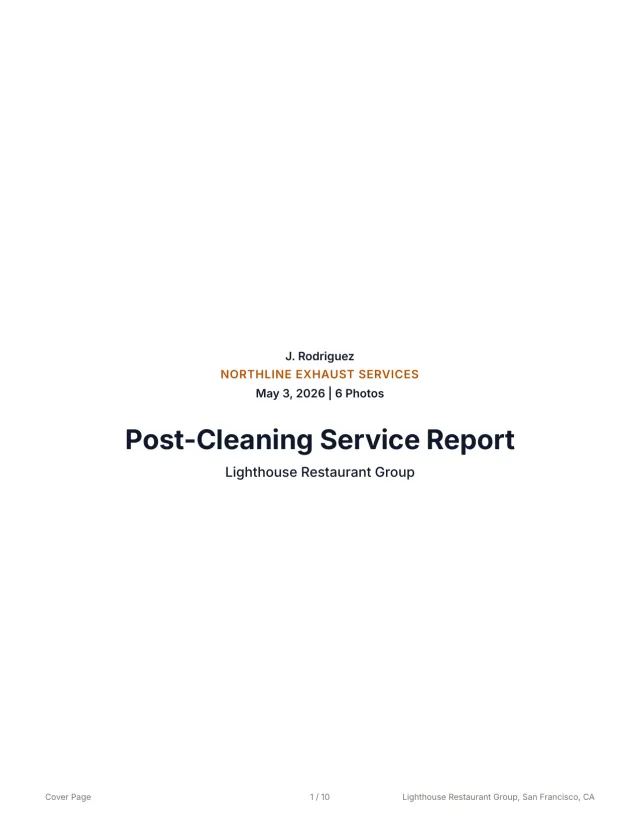 See a finished report The 10-page sample, the Certificate of Service, and the 3x5 sticker from one job.
 Related guides
Keep building the report record
Use this NFPA 96 inspection checklist to document kitchen exhaust scope, visible conditions, access, photos, deficiencies, frequency, and AHJ handoff.
Standards Commercial Kitchen Hood Cleaning Code Requirements ChecklistDocument commercial kitchen hood cleaning code requirements: scope, NFPA 96 records, access, deficiencies, photos, frequency, and AHJ handoff.
Standards Hood Cleaning Certification, Licenses, and Service RecordsCompare hood cleaning certification, licenses, costs, online training, NFPA 96 documentation, certificates, and service records for contractors.
Send your next job as a finished report.
Your photos become a branded report, a Certificate of Service, and a 3x5 sticker, under one job number.
3 reports or 3 days free. No card.